american urbanism focuses too much on biking infra and other minutiae and misses the big picture
I’ve moved to NYC now from the bay area (and previously LA where I grew up) and talking with people here but especially back home who might be interested in urbanism reveals to me what i consider to be a slight misunderstanding of the…
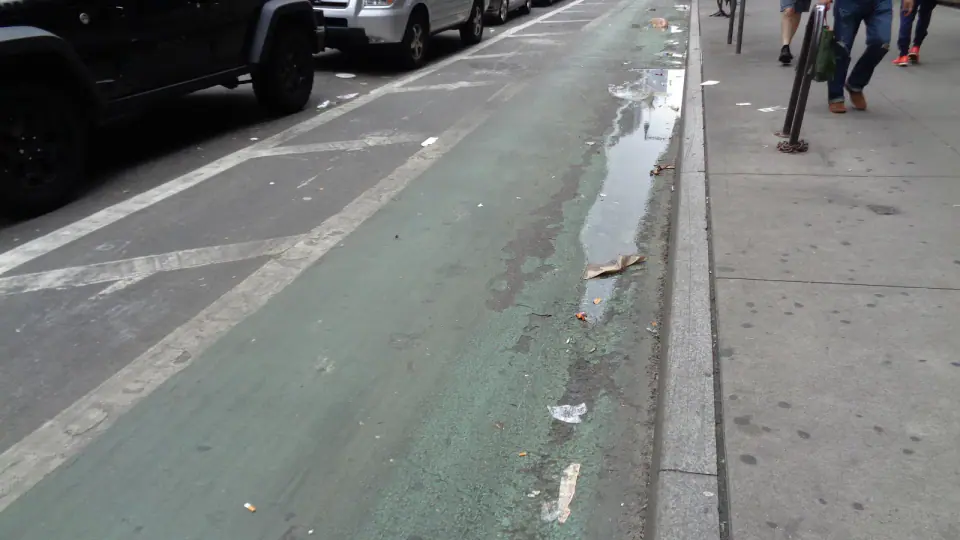
Photo by Tdorante10 on Wikimedia Commons · CC BY-SA 4.0

I’ve moved to NYC now from the bay area (and previously LA where I grew up) and talking with people here but especially back home who might be interested in urbanism reveals to me what i consider to be a slight misunderstanding of the big picture of why urbanism is important and how to go about it.
For instance, most urbanist people in American cities, even the biggest one NYC, are focusing a lot of their mental effort on how we need more bike lanes. And I agree that bike lanes are an important part of a diverse ecosystem of modalities of transport that can make a city serve everyone, and even be green. But a lot of people, in my opinion, overindex on how much good biking infrastructure can provide and miss the bigger picture of the relative priority of modes of transport.
Bikes are still private vehicles. They still require lanes, and for everyone who hates on cars because roads “aren’t spaces”, well bike lanes are just roads painted green and are still just as much not “spaces”. At the end of the day, you can’t stand in the bike lane and experience something, whether it is exchange of goods, arts, culture, services, or etc, just as much as you can’t do that standing in the road. These are thoroughfares of transportation.
In my opinion, the ranking of transportation priority is as follows:
walking
subway
elevateds (provided they aren’t noisy)
trams (same grade as motor vehicles on the road)
buses
cars/trucks/private motor vehicles
bikes
I think a lot of American urbanists wouldn’t agree with me putting biking so far down but allow me to explain. Ultimately in a city that serves you properly, you should either be walking to your destination, or walking into a magic translating rectangle (a subway) and then walking out of that into your destination, or using a car/truck/other motor vehicle because you have to haul a lot of things or you need special equipment like the folks in nyc who routinely test the water quality and need the truck nearby, or (of course) you are doing construction. I’m sure we’ve all seen construction vehicles hauling tons of materials, even concrete trucks, that have no choice in nyc but to park in the bike lane. I even saw a brigade of 4 concrete trucks where each driver had a headset on to coordinate when they could advance to job site, they were parked in different locations around it on different streets. We all know that as much as we want to get rid of the parking lane, it’s just not technically possible because people don’t exist in a vaccuum, restaurants need a car to come with food, stores need supplies, people need “stuff” and you can’t just teleport the stuff through the bike lane to the curb, nor can you build an underground set of freight only highways with elevators below each building (think about how those long 2x4s are going to all fit in some elevator).
There’s just no way around the reality that sometimes vehicles need to park on the side of the road.
But things like this produce conflicts with bikes. Bikers in nyc or otherwise, upon seeing vehicles parked in the bike lane, will have to merge into the street to avoid them, producing conflicts with car traffic. Bikers have priority to cross streets which can produce conflict with motor vehicles turning left or right. I have friends who biked, in the bike lane, in nyc who got injured after a car in the parking lane opened their car door without looking and sent my friend to the floor. Now with e-bikes in the mix, bike injuries are going up in NYC as bikes are going faster.
I know what you might be thinking at this point, I should be blaming the cars not the bikes right, why am I hating on the bikes when the cars are whats polluting the environment. But you have to understand that even if we reduce private vehicle ownership and car traffic goes down, there’s still an enormous need for commercial vehicles and those are still vehicles that drive like any other car or truck and the same conflicts will still be present.
Ultimately if you agree with my ranking above you will agree with the following statement: if people are taking a bike for reasons other than leisure it means the mass transit system isn’t servicing them. Ultimately people’s navigation in a city is predictable. People go in to work and then go back from work, and go from neighborhood to neighborhood. Just look at the comments on any post about the IBX (which totally needs to be a thing btw, support queenslink!), and you’ll see all of the brooklyn residents lamenting that the quickest way to queens via transit is so long because you have to go through manhattan (and vice versa for queens residents to brooklyn). The trips that people make can be predicted, modeled, studied, and then made easier with mass transit. Ideally everything should be a subway, but if it’s not a subway it could be an elevated, and if its not grade separated it could be a tram, and if its not that it could be a bus, but it should be something unless there’s really nobody doing that route but one person.
As an urban planner it’s your responsibility to take people’s taxes and then use that money most effectively to make as many people’s lives easier as possible with respect to urbanism.
What this means is that adding a bike lane is cool but that just services people who can bike (either have or rent like citi bike) and even then the throughput of that bike lane is literally nothing compared to a bus lane, and at least a bus everyone can take able bodied or not. And even better would be a subway so when 5pm hits and there’s traffic, you can still go home since the rail isnt going to be affected by street traffic. If you only have enough money to paint the road green I can understand, but as a society we shouldn’t be afraid to shoot for the stars.
The only way NYC became the powerhouse it became today was through it’s subway infrastructure. Without that, there’s no way we could take people from all of these boroughs (sorry staten island) and other states like nj and ct via other rail, into NYC to work, and then back out to go home, and do that every day. Can you imagine if the city planners of NYC just added bike lanes? nobody is going to be able to bike the enormous distances that some of our express trains can traverse in like 20 - 30 minutes to work, and then find somewhere to put their bike (or car if we’re talking CA), and then go all the way home and do that every work day.
NYC became the most financially and culturally prominent city in the world through rail.
Rail is far and away way more efficient at transporting large masses of people to and from places than any other modality of transport we’ve discovered as a civilization. Tokyo (if you consider all the wards) is easily the largest city in the world, and manages to be so while still being clean, safe, and not even particularly stressful. If you look around Tokyo’s urban core, you won’t really find any biking infrastructure. It’s basically just sidewalks, subways, and streets. You can bike in Tokyo but the fact that people aren’t doing so much (except within a chome) is ample evidence that the subway stations in Tokyo are spaced out quite logically, and Tokyo also makes sure to put most of its urban core as close as possible to train stations as possible, as opposed to the park and ride system in CA with the caltrain or other commuter rail systems in the country which often are the only rail systems some cities here have.
I want to step back for a bit and dissect “urbanism”.
What is the problem that we are actually solving here?
Are we trying to be a greener civilization? I.e. is the main motivating factor that we need to do “less” with “more”? I feel like this is often the verbiage I hear in America by urbanist advocates, that we need to bike more and invest more in biking infrastructure because we need to take care of the planet and reduce carbon emissions. I understand this viewpoint but to me it feels completely topsy turvy. Allow me to explain:
Human being fundamentally enjoy “engagement”. This is something you learn from first principles with game design. People crave being engaged, even if they can’t express it or point it out. Have you ever had a conversation with your best friend only to look at the time and see three or four hours have gone by but you didn’t even notice? And for a brief moment you’re like wow we’ve been talking for so long! But then immediately afterwards you realize you don’t regret it somehow, despite the fact that you had things you were planning on doing today. You ever just sink into a movie, or a game, or any piece of media (i hear binging is up by some metrics), and then come away similarly, marveling at the apparent passage of time but then subsequently not regretting anything since you enjoyed it. This phenomenon isn’t restricted to media or good conversation, good cities can be engaging in this way. Think about the first time you went to NYC, or Tokyo, or Seoul, or London (I’ve not been to London just yet). Walking around felt like magic, there was so much to see (probably lots of tourists, but just imagine if there were fewer tourists bothering you for the sake of this discussion). You walked around for hours every day marveling at everything, eating good food, playing games, hanging out with friends, enjoying LIFE. And then if you live in most places in America, you went back from that trip to your sleepy suburb and spent most of your time indoors or perhaps wandering around your park.
The reality is that you can’t copy the urbanism of these world class cities without copying the REASON there was any push for urbanism there in the first place, which is that there is a high density of PLACES there that people WANT to go to.
Ultimately the issue with America in my opinion isn’t that there isn’t enough biking infrastructure or even rail or what-have-you. It’s that there aren’t enough places in our cities that people actually want to be in and enjoy. That’s why our cities have gotten so empty during Covid when people didn’t need to go in to the city for work anymore, because a lot of urban cores in American cities were just office buildings, and the other things weren’t interesting enough (and in large enough volume) for people to want to go there.
Ultimately the cities in Europe and Asia we talk so much about copying started out in olden times as walking cities with the majority mode of transport being walking, and things started from there, then when the city had too many people, it expanded and as it expanded it’s planners thought about solutions for getting people around.
You can’t have the tail wag the dog, people (Americans) won’t really care about any urbanist initiatives within their cities if they don’t even want to go spend the day WALKING around their cities anyways. Because even if you add bike lanes, those are still roads and not spaces, people need to disembark from their bike or whatever vehicle at the destination that they ultimately want to be at and walk for the majority of their time there, not everything is about transport.
European and Asian cities are designed for walking and everything else is in service of that. American cities are designed around driving so trying to retrofit in biking or even mass transit too feels odd when once you get their via these greener or more efficient transport methods, you still need to take them again to get to the next destination instead of it being a continuous walk. So even if we copied amsterdam to a T and got all of their amazing biking infra, american would still have the same issue of lack of places its just we would be commuting between different things in a slightly greener way.
This is honestly what makes nyc such a world class city in my opinion. it’s even denser than paris. There’s just such a enormous density of generally cool and interesting things here that makes the other things i have to give up to live here seem completely inconsequential. i felt like when i talk with california people who are kinda part of the urbanist mindset they want to copy the bike infra and subways of nyc and yeah absolutely but even if sf had better subways as a human i still wouldnt move there. the thing that other cities in the US need to copy from NYC in order to get walkability is they need to copy the amount of cool things that are outside here and then walkability will come from the change in mindset where now your residents actually want to walk from place to place all of a sudden and you can design around that. That’s how it’s happened in other world cities in Europe and Asia anyways.
In summary, you can’t always design a mode of transport and just expect people to take it.
People will do either what is quickest (which is often driving if they have a car), or what is most engaging, which can be walking if you’re in a dense city. If you are an urbanist in favor of supporting a lifestyle that is fun and engaging, instead of thinking in a reductive mindset of how can we take away (i.e. make us be able to do the same with less (i.e. bike the same distances instead of drive)), try thinking in an additive mindset (i.e. what would make people want to come here so badly that they wouldn’t care giving up their cars, bikes, or other motor vehicles and just walk around here all day? Ok great, now let’s service their non walkable trips, and lets service the commercial vehicles required to maintain the things in that city that they want to experience.). (This is kind of the same psychological thing at play with the difference between balancing a game with nerfs vs buffs lowkey).
In this way, the energy efficiency of forward thinking urbanism gets way easier when people want to WALK which doesn’t burn fossil fuels unless you just fart a lot of methane when you walk I guess. Walking is the holy grail, if you tell people to bike a distance that they feel more comfortable driving, no matter how much you talk about the environment they are going to drive. To get people to take other forms of transport and get closer to the holy grail of walking you have to bring things closer together. People will always follow paths of least resistance, and if you’re an urban planner powered by taxes, it’s your fiduciary duty to service the people who elected you and design for paths of least resistance and try to add to their lives instead of subtract.
The ultimate goal of urbanism is to figure out how to design our environments to support healthy, happy, engaging lifestyles for as many people as possible considering they are all paying taxes (hopefully).
I’m not saying that any of that is financially within reach for most American cities, but we should be aligned on what the north star looks like so that we are spending the money that we have wisely, advocating for the correct things, and keeping in mind what made the cities that we want to copy so badly great in the first place. And ultimately that is going to be walking and rail (subway, elevated, commuter, etc). Biking can exist in that ecosystem, and definitely should, but shouldn’t be an urbanist bandage: i.e. we can’t just paint a lane green and call it a day, even add bollards, there’s a reason for other cities’ success and we need to be cognizant of that bigger picture.
Originally published on Substack. View the source version ↗
Comments